
When we look at a finished round brilliant diamond, its perfect, symmetrical circumference is often taken for granted. Yet, achieving that crisp, circular outline—the girdle—is one of the most mechanically demanding phases of the cutting process. This is the art and science of bruting (or girdling).
At S. Muller & Sons, our heritage spans generations of Antwerp diamond cutting. Over the decades, we have witnessed a massive technological shift in how a diamond is shaped. Let’s take a look inside the factory at the machines that make it possible.
What is Bruting?
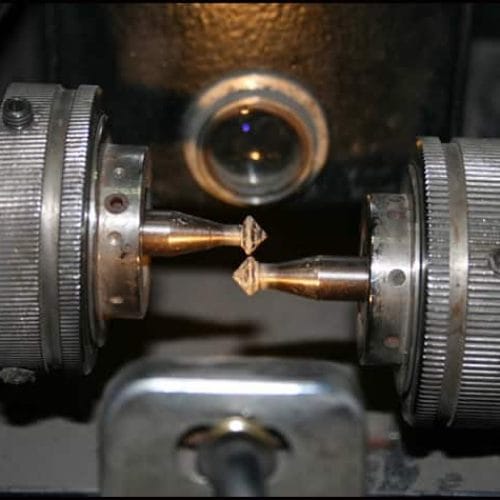
Before a diamond can receive its 57 brilliant facets, the rough stone must transition from its irregular natural shape into a basic aerodynamic form. Bruting is the specific step where the rough stone’s corners are rounded off to form the girdle. Because diamond is the hardest known natural substance, only a diamond can cut another diamond.
The Core Principle: Two diamonds are mounted on opposing axes. As they rotate against one another, the friction wears away the sharp corners of the rough stone, gradually creating a perfectly smooth, circular perimeter.
The Technological Journey: Three Eras of Bruting
1. Traditional Mechanical Bruting (The Late 19th to Mid-20th Century)
For decades, bruting relied on purely mechanical lathes. A master cutter mounted the rough diamond onto a spinning chuck, while a second diamond (the “sharp”) was attached to a long wooden stick called a turn-stick. The cutter wedged this stick under their arm and manually forced the two stones together.
Later, semi-automated mechanical bruting machines introduced dual-spindle setups where both stones rotated simultaneously, but the feed rate, alignment, and pressure were controlled entirely by the artisan’s physical touch and trained ear.
2. Automatic Bruting
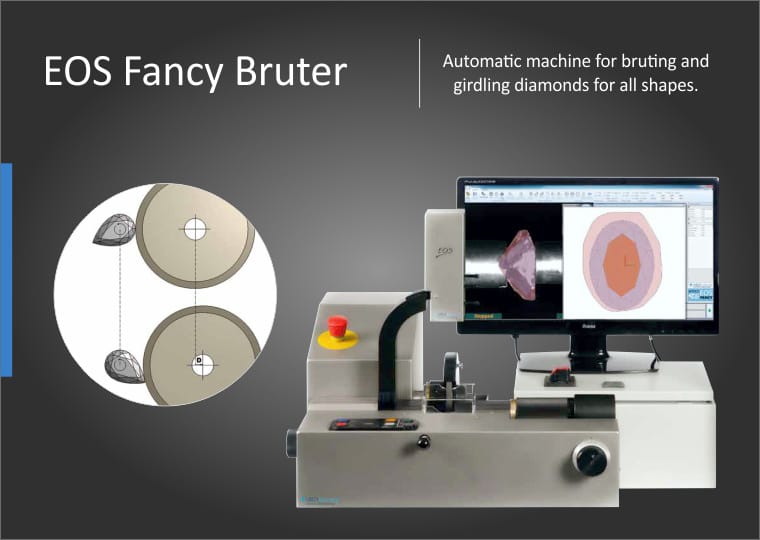
The introduction of automatic bruting machines allowed operators to set precise mechanical parameters, minimizing the risk of structural damage or human fatigue.
Many factories adopted what is called a EOS Water Bruting Machine, which reduces the risks of chipping the diamond while bruting.
This era also saw the integration of laser bruting. Instead of using mechanical friction from a second stone, a high-intensity Nd:YAG or fiber laser vaporizes the outer edge of the diamond to cut the circle. While highly precise and efficient for heavily included stones or complex fancy shapes, laser cutting leaves a dark carbon skin that must be polished away.
3. Advanced CNC & Double-Stone Digital Bruting (The Modern Standard)
Many modern workshops rely on fully automated, computer-numerical-controlled (CNC) bruting systems.
- 3D Optical Monitoring: High-resolution cameras analyze the stone’s symmetry in real-time, displaying a magnified silhouette on an external screen.
- Optimal Yield Allocation: The machine’s software cross-references the bruting progress with the original 3D rough scan to ensure the maximum possible carat weight is retained.
- Dual-Axis Control: Both spindles automatically adjust their RPM (Revolutions Per Minute) and contact pressure dynamically, preventing the stone from overheating or fracturing along internal stress lines.
Why Machine Precision Matters for the Final Polish
A perfectly executed bruted girdle is the foundation of a “Super Ideal” cut. If a bruting machine lacks precision, it can introduce micro-feathers (tiny structural fractures) or result in an out-of-round girdle.
By matching our generations of artisanal expertise in our Schupstraat factory with modern CNC stability, we ensure that every diamond we polish achieves maximum light return, pristine structural integrity, and exceptional symmetry from the very first cut.
Interested in seeing how our master cutters transform rough stones into certified Antwerp brilliance? Contact our office at office@muller.be or schedule a digital consultation with a diamond specialist.