
When most people think of a diamond, they visualize the sparkling, multi-faceted brilliant
cut that catches the light from every angle. However, for those of us at the polishing bench,
the journey begins much earlier. Long before a diamond reaches the display case, it exists
as a “rough” stone—a raw stone shaped by immense pressure and heat deep within the
Earth. Understanding these natural forms is the first step in unlocking a stone’s ultimate
potential.
In the world of diamond polishing, our primary goal is to maximize two things: the beauty
of the final gem and the “yield” from the original rough. Every natural shape presents a
different puzzle. By analyzing the crystal structure, we decide how to map out the facets to
hide internal inclusions while retaining as much of the precious material as possible. Here,
we explore the most common shapes we encounter in their raw state.
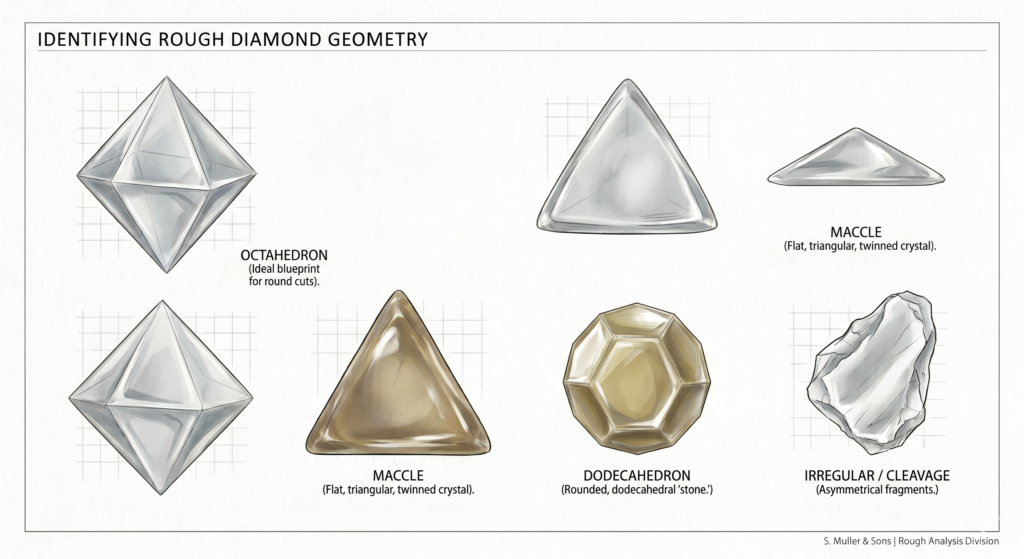
The Octahedron: The Ideal Blueprint
The octahedron is perhaps the most sought-after shape in the rough diamond trade.
Resembling two pyramids joined at their bases, this eight-sided crystal is the “textbook”
diamond shape. Because of its symmetrical structure, it is the perfect candidate for
creating a round brilliant cut. Often, an octahedron is sawn into two pieces, allowing us
to produce two high-quality stones from a single rough crystal.
Dodecahedrons and Rounds
Nature is not always perfectly geometric. Many diamonds surface as dodecahedrons—
twelve-sided crystals that appear more rounded than the sharp octahedron. From a
polisher’s perspective, these “rounds” or “stones” are highly efficient. Their curved
surfaces often mean we have to remove less material to reach a finished circular shape,
though the internal grain lines can sometimes be more complex to navigate during the
cutting process. Some of them we call “bollekes”, or balls, and these also allow a high yield.
Maccles -Triangular shape
Maccles are flat, triangular crystals that are actually “twinned” stones. They form when
two crystals grow together but are oriented in opposite directions. Because they are
relatively thin, they are rarely used for deep cuts like the round brilliant. Instead, we
look to maccles to create beautiful heart shapes, triangles, or pear cuts. The challenge
with a maccle is the “twin plane” in the middle, which requires expert handling to
ensure the stone doesn’t fracture.
Cubes and Cleavages
Rough diamonds can also form as cubes, though these are more common in industrial-
grade material. When a diamond has an irregular or broken shape, we refer to it as
“cleavage.” These stones often have internal stress or have been fractured during their
journey to the surface. While they require more care and planning, cleavages can often
be transformed into unique “fancy” cuts that follow the natural silhouette of the
fragment.
At S. Muller & Sons, we see the potential in every rough stone, whether it is a perfect
octahedron or a complex maccle. The process of “mapping” a stone involves using advanced
technology to peer inside the crystal, identifying the best path to transform raw mineral
into a masterpiece of light. Diamond manufacturing is challenging, and we are proud to sit with our clients in our Antwerp factory so we can analyze together the best options for an optimal polished diamond.
Understanding these shapes helps collectors and enthusiasts appreciate the craftsmanship
involved in every polished diamond. The next time you admire a finished ring, remember
that its journey began as a unique, rugged crystal, carefully shaped by hands that
understood its natural geometry long before it ever sparkled.